
Thatch and organic matter buildup can limit turf performance by restricting water movement, nutrient availability, and soil activity. Managing this layer is key to maintaining healthy, high-performing surfaces. Effective thatch management helps unlock nutrients tied up in organic matter, improves microbial activity, enhances seed-to-soil contact, and supports warmer soil temperatures for earlier green-up. Bio Reverse DG is designed to accelerate natural decomposition, strengthen soil biology, and improve overall rootzone performance across golf, sports turf, and professional landscape environments.
What Is Bio Reverse DG?
Bio Reverse DG is a biological soil amendment that combines:
-
Microbial strains selected for their ability to break down cellulose, lignin, and other complex organic compounds
-
69% humic acids that provides a carbon-rich food source that stimulates microbial growth and activity
-
Dispersible Granule (DG) Technology ensures granules disperse quickly with moisture, moving into the soil profile instead of sitting in the canopy, unlike many liquid formulations that can remain more surface-focused without sufficient irrigation
This combination allows the product to efficiently integrate into the soil and activate biological processes that support healthier turf.
How It Works
Bio Reverse DG enhances natural processes by introducing specialized bacteria that target tough organic materials like lignin and cellulose.
In addition to these microbial strains, the high humic acid content plays a key role by providing a readily available carbon source that helps feed and sustain both the introduced bacteria and existing native microbial populations in the soil. This creates a more active and balanced biological environment, improving microbial colonization, nutrient cycling, and overall soil function
Rather than relying on bacteria alone or on liquid-applied biology that may be more dependent on immediate environmental conditions for performance, Bio Reverse DG supports a system where biology is sustained and performing over time.
Targeted Bacterial Strains
Each microbe plays a specific role:
- Bacillus cellulolyticus: breaks down cellulose to accelerate nutrient release
- Bacillus ligniniphilus: targets lignin, one of the toughest components of thatch
- Rhodopseudomonas palustris: Breaks down organic acids and lignin in both aerobic and anaerobic conditions
- Saccharomyces cerevisiae (yeast): Serves as a food source to support microbial colony development
Together, these strains deliver 1.5 billion CFUs per pound, driving efficient organic matter breakdown.
Consistent Nutrient Release Over Time
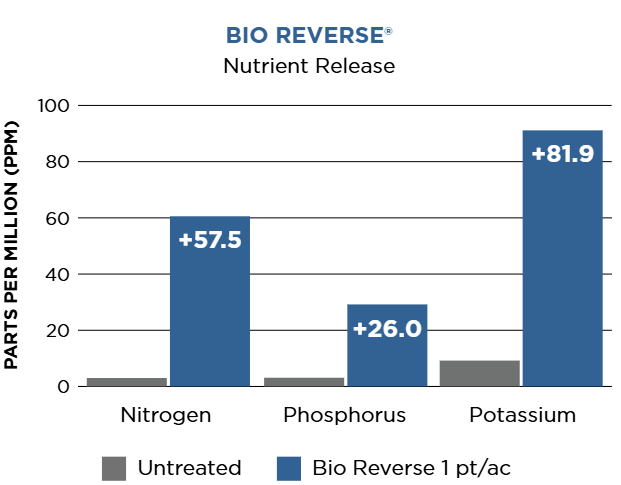
The chart below illustrates how nutrients are released over time, ensuring consistent performance in the turf. Bio Reverse was applied and the nutrient value of rainwater was collected. The Bio Reverse treatment had significant residue breakdown, releasing ten times more nutrients compared to the untreated check.
Key Agronomic Benefits
By improving biological activity and organic matter breakdown, Bio Reverse DG delivers measurable turf benefits:
- Accelerated Organic Matter Breakdown: Helps reduce thatch and surface organic layers that impede water infiltration and root development.
- Increased Microbial Activity: Enhances the soil’s biological environment, promoting nutrient mineralization and improved soil function
- Improved Nutrient Availability: Releases nutrients tied up in undecomposed material, supporting efficient plant uptake
- Better Soil Structure: Humic acid strengthens aggregation and rootzone performance for healthier, more resilient turf.
Application & Best Practices
For best results, Bio Reverse DG should be used as part of a consistent turf management program, not a one-time application. For turf areas with significant thatch accumulation, apply at the high rate of 5 lbs. per 1,000 sq. ft. every three months until the desired level of thatch management is achieved. Once thatch levels are under control, transition to annual or bi-annual applications to help maintain optimal conditions.
Recommended use:
- Apply during peak turf growth periods (spring through fall)
- Use post-aerification to maximize soil contact and performance
- Suitable for golf courses, sports turf, and lawn & landscape
- Reapply annually (spring and fall) for long-term result
Once organic matter levels are brought under control, applications can often be reduced to an annual maintenance treatment. Because the product is delivered in a granular form, it can also simplify application compared to liquid programs, reducing mixing, handling, and application variability while maintaining consistent coverage.
Important considerations:
- Bacteria are dormant (sporulated) and activate with moisture and heat
- Optimal activity occurs at 55–75°F soil temperatures and activity slows below 45°F
- Avoid applying alongside nitrogen stabilizers or inhibitors, which may reduce microbial effectiveness
Storage & Stability
Bio Reverse DG is designed for reliability, from storage all the way to application. Its sporulated bacteria provide stability and ensure a shelf life of up to two years. For best results, store the product in cool, dry conditions and avoid prolonged exposure to heat or moisture before use. Compared to liquid biological products, this granular formulation offers better shelf stability and consistency. Liquid products are more sensitive to temperature and handling, and microbial viability can decline over time. Additionally, because Bio Reverse DG is not a liquid, it avoids many of the storage, handling, and consistency challenges associated with liquid biology, giving turf managers a more dependable and easier-to-manage option in the field.
A Smarter Approach to Soil Health
Bio Reverse DG delivers a proactive approach to improving thatch breakdown and soil performance. By combining targeted microbes, humic acids, and DG technology, it helps turf managers improve soil health, unlock nutrients, and maintain stronger, more resilient turf.